Log in

Why do you play brilliant chess some days and keep blundering on others?
Chessing finds the habits behind your best and worst games, so you can repeat the good days and avoid the bad ones.
- See which habits shape your best games
- Meet players who live like you
- Unique puzzles & quiz duels
Slide the pieces around the wooden board using their chess moves.
How it works
1. Link your chess account
Connect your Chess.com or Lichess account. We check that it's yours.
2. Log your day
Sleep, food, stress, screen time, the people you spend time with and more. Takes a few minutes.
3. See your patterns
Find out which habits line up with your best games, and which with your worst.
What you get
Your patterns
Compare your best, average and worst days, and see how your ratings change with your habits.
Honest AI summaries
Read an AI-written summary of your patterns. It's a starting point to explore, not a verdict.
Community and prep
Find players with similar habits, and prepare for opponents using their past games.
Puzzles and quizzes
Unique chess puzzles, a new daily puzzle to compare with friends, and quiz duels.
Take a look at what the AI report would include
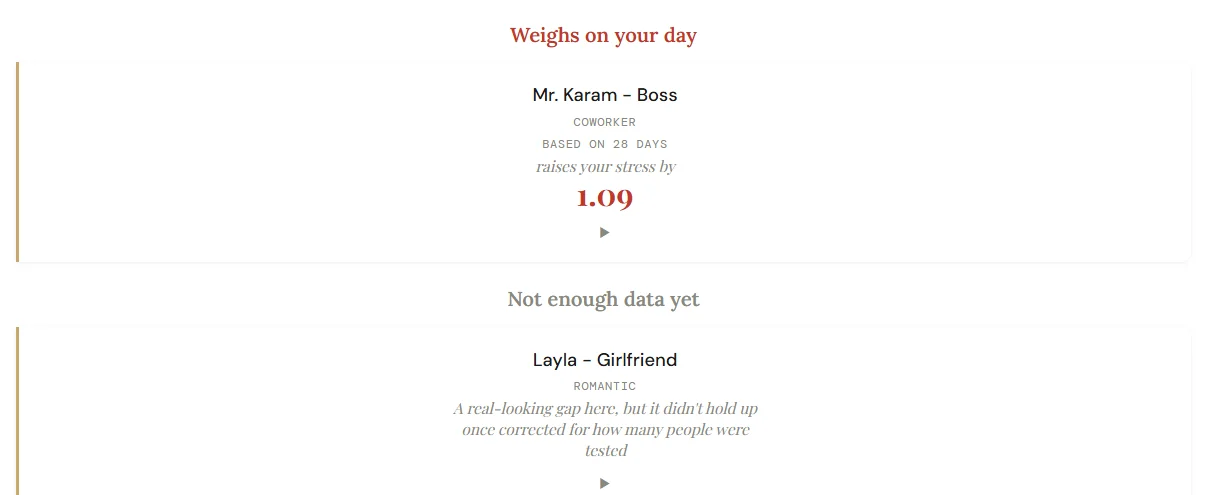
An example built from sample data. The names and numbers aren't real people.
Work is the biggest factor in your chess days. You worked on 28% of your best days and 84% of your worst. Heavy work days show the same split, none on your best days and 19% of your worst. Hours on the days you did work were close across bands, so it's less about how long and more about whether you worked at all, and how heavy that day felt.
Having caffeine in the morning goes with better chess days. It's one of the patterns in your log. Mornings with coffee logged tend to line up with stronger days later on. It's a small lever next to work, but a real one.
More social interactions in a day go with worse chess days. The more people you interacted with on a given day, the lower your performance rating tended to run. It's not that people are bad for your chess. Busier, more socially loaded days just tend to be the weaker ones.
Working out the day before goes with better chess days. You were preceded by a workout on 56% of your best days, compared with 32% of your average days and 19% of your worst.
Higher mood, on its own, comes with worse chess days for you. Most people expect feeling good and playing well to go together, but in your log the two move in opposite directions.
PS5 shows up far more on your best days than your worst. It appeared on 64% of your best days versus 32% of your worst, the kind of activity you might expect to compete with chess, not line up with your good days.
Liam ("Crush"), your romantic interest, is the biggest mood lift in your log. You were together on 24 of your 90 days, and mood runs clearly higher on those days, 8.2 versus 6.4, and that one is proven, not a hunch. The interactions you logged with him were 16 positive and 8 neutral, none negative. Stress runs very slightly higher around him, 4.9 with him versus 4.8 without, but that hasn't cleared the bar as real. Your notes repeat a couple of lines: "Hung out for a bit" on 9 of those days, "Talked in the hallway" on 15 more. He also shows up in your stress notes. "Thinking about Liam" appears on 12 of your stressful entries, and separately, on a best-band day (2026-05-12, rated 6) and on 2 worst-band days (most recently 2026-03-19, rated 4), you wrote "Keep thinking about Liam, can't concentrate." The mood lift is real; the concentration side is a more mixed story.
David, a friend, is the one relationship in your log that doesn't add up cleanly. The interactions you logged with him were 4 positive and 8 neutral, zero negative. But mood is lower on the days you saw him, 5.2 versus 7.1, and that drop is proven. Those two signals disagree, and the log can't tell you which one is right. Stress is a clearer story on his days: it runs higher, 6.8 versus 4.5, and that's also proven. Every one of his 12 logged days came with "Study group" written down, and you last saw him 16 days before your last entry, on 2026-05-26.
Lama ("Best Friend") is where your stress is proven lower. On the 15 days you spent with her, all 15 logged interactions were positive. Stress drops from 5.0 to 3.8 around her, and that's proven. Mood is also higher on those days, 7.5 versus 6.7, though that difference hasn't cleared the bar yet. Your notes on these days read "Phone call" on 7 of them and "Hangout" on 8 more. She was part of your days right up to the end of this log, a steady, calmer presence.
Your privacy
- We don't sell your data or use it for advertising.
- You choose what your friends can see.
- Under 16? A parent or guardian must approve your account first.
- Read the full Privacy Policy and Terms of Service.
Questions
- Is it free?
- Yes, for now. If we add paid features later, we'll tell you at least 30 days before any charge starts.
- Which chess platforms work?
- Chess.com and Lichess.
- How long does setup take?
- Linking your chess account takes a minute. Logging a day takes a few minutes.
- Is my data sold?
- No.